- A Self Organised Structure for the Tornado
pageid = 3501 parentid = 7692 - A Self Organised Structure for the Tornado Don't dismiss this theory on the grounds that the electromagnetic fieldproduced by a moving charge is many times smaller than the electrostaticforces produced by the same charge. Or calculate on the basis of large pointcharges. In a gas, the forces apply to a single molecule or a single electron.There is no aggregation of charge. Read right through, and assess whetherthis theory accounts for the points made by observation of tornadoes. ... Click this link to see larger image This theory has proposed that the tornado tube is highly electrostatically charged, and the opposing aerodynamic forces, electrostatic forces and electromagnetic field, together produce a vortex tube with considerable shearstrength. The charged vortex sheath bites into the ground rather like a holecutter. A tubular narrow blade rotating at high speed moving over theground surface. Because the electromagnetic field is solenoidal, it can be intenseinside the tube, but very small outside the tube. To measure it you needinstruments underneath the vortex path itself.
... Click this link to see larger image The result is a turbulence vortex of dust and air rising, surrounding the charged sheath vortex of the tornado at its centre. The Anatomy of a Large Tornado When we watch a large tornado, what we see is the rising turbulence vortex of dust and debris, but at its core it is powered by a charged sheath vortex of extreme ferocity and strength. From http://www.kwtv.com/wx/wxcenter.htm is tornado2.mov(389K) A or tornado2.mov from cache A huge tornado, but most of what we can see are hanging plumes of ejected material, in a gently rising and gently rotating air stream. The violence of the charged sheath at the core is not visible. When we examine the debris field after the tornado has passed, the broadest part is a band of destruction caused by the inflowing winds of the turbulence vortex, but at the core is a narrow band that has felt the teeth of the charged sheath itself and the ground surface shows the striations as the surface was pulled apart. Small debris such as straw can become entrained in the charged sheath and then behaves as though it was part of a rigid solid, driving the debris through wood orsteel. The charged sheath can also rip and twist metal structures under theground surface protected from any wind, but fully exposed to the violent magnetic fields at the end of the vortex tube. You are welcome to join the discussion, but please note that any claims you make for or against these theories should be backed by scientificreasoning that can be developed from first principles.
This theory proposes that the tornado forms from the rotation (round a vertical axis) of a large volume of cloud which carries an electricalcharge.
Such rotation has been measured in many clouds using doplar radar, and the rotation of clouds prior to the formation of tornadoes has been filmed.
The electrons that give such a cloud a charge are attached to molecules of N2 or O2 or water vapour. Only a small proprtion of these air molecules will carry this excess charge. The majority of molecules will be electrically neutral.
The molecules in a cloud of gas are moving randomly in all directions in proportion to their temperature, and near collisions between these molecules give rise to the gas pressure. The charge particles will similarly be carried in all directions.
In a rotating cloud, there is an overall flow of these molecules in the direction of rotation, which is the net flow of this random movement of molecules in the direction of rotating.
We cannot therefore consider the effects produced by these molecules, as being molecules moving in parallel - because they are not. We can compare the net result of these molecules random movements against the net results of the random movements of all the molecules in the cloud.
This theory is based on the following forces:
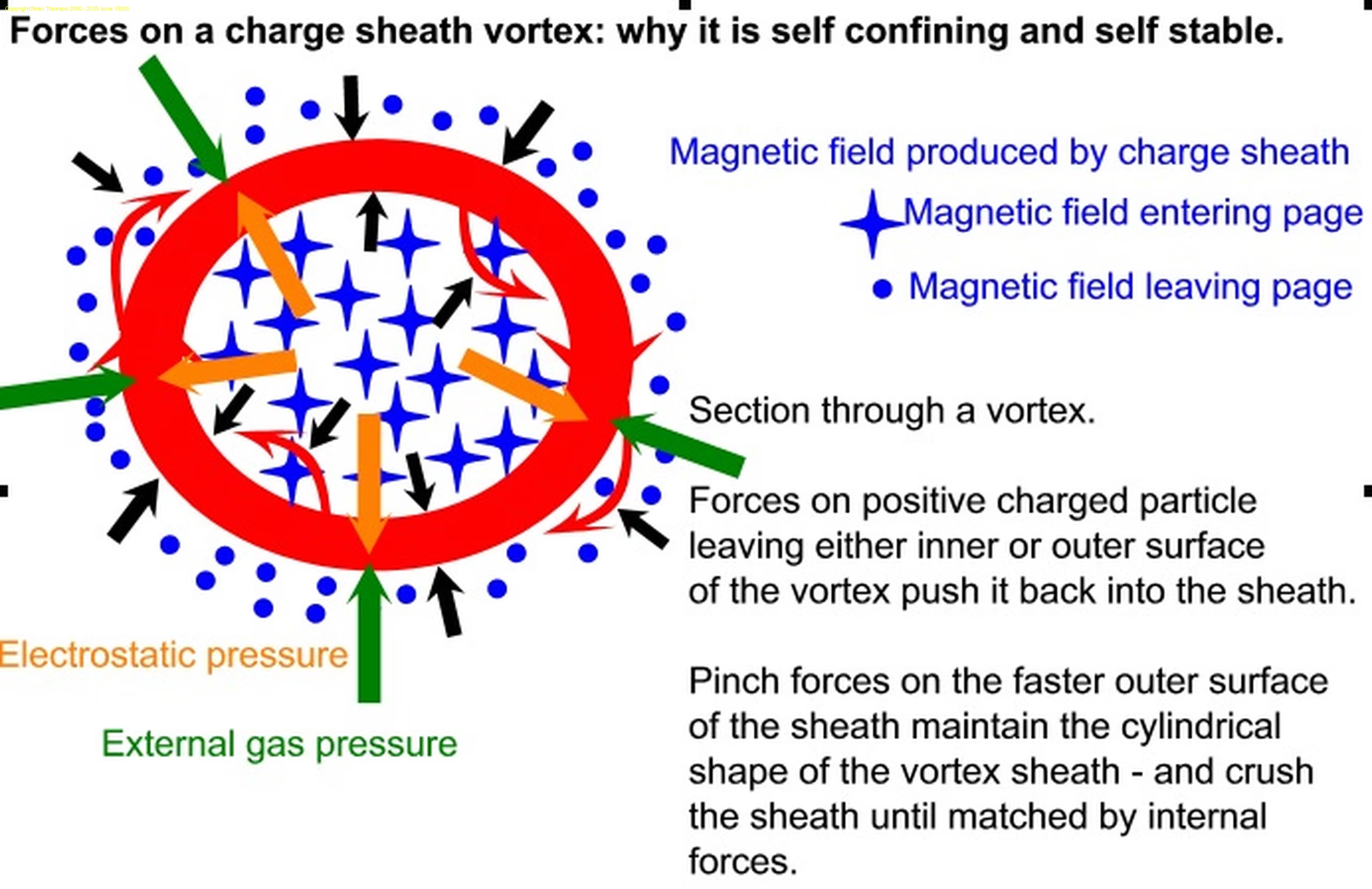
Each moving charge will create an electromagnetic field round itself. The sum of the magnetic field produced by the random movements in the direction of rotation will produce a solenoidal magnetic field round the verticalaxis of rotation.
The electrostatic charge on each charged molecule will repel others, but in a large charge cloud this will be approximately the same in all directions.
Electrostatic charge between charged molecules can cause increased separation of these molecules - an electrostatic pressure - that opposes the surrounding air pressure. This electrostatic pressure causes a slight decrease in density in the the charge cloud, but it is otherwise stable. The electrostatic pressure can be balanced by the air pressure, so that the charge cloud does not fly apart under mutual repulsion of charge.
In a cloud that has an electrostatic gradient, neutral molecules form dipoles that experience a force that attracts them towards a point of increasedcharge.
Development of these forces within a rotating charged cloud.
Continued development of the rotating charge cloud.
Equilibrium state for the rotating cloud.
Electron cascade
The vortex tube.